
 Home »
How AI Tracks You via Mouse & Scroll: 2026 Privacy Study
Research by Stands Research Lab | Focus: Behavioral Biometrics & Web Privacy | Date: June 2026
Written by Roy Rosenfeld, CEO, Stands
Abstract
In June 2026, Stands Research Lab completed a 3,000-session analysis of web browsing behavior with one central finding: AI now identifies a returning user with 88.2% accuracy from mouse movements alone in a median of 12 seconds, without relying on cookies, IP addresses, or login data. The tracking persists through VPN connections and Incognito mode, and to evaluate this mechanism, we measured telemetry data across desktop and mobile devices using a Recurrent Neural Network (RNN) architecture. Our results show that static privacy tools fail because motor habits create a persistent physical signature. The only effective technical defense injects sub-pixel noise at the API layer to introduce controlled signal jitter. Without immediate regulatory reclassification of behavioral telemetry under biometric protection laws, stateless identification will remain an unmonitored surveillance vector across the open web.
Section 1: The End of Cookie-Based Privacy
Tech companies presented the deprecation of third-party cookies rolled out across major web browsers between 2024 and 2025 as a structural victory for consumer privacy. It was not. Rather than ending user tracking, the removal of cookies pushed web surveillance underground into stateless identification mechanisms that operate silently, leave no local storage footprint, and defy user deletion.
Stateless tracking relies on server-side analysis. In cookie-based tracking, the browser writes a file to client storage, allowing users to inspect or delete it. Stateless tracking writes nothing to the client machine. The tracker passively collects real-time event streams from standard web APIs, processes those signals on a remote server, and constructs a profile. Because the browser maintains no state on user hardware, traditional cookie banners and cache wipes offer zero protection.

Behavioral uniqueness forms the foundation of this transition. As a handwriting analyst evaluates pen pressure and spacing to identify a writer, machine learning models analyze the physical execution of digital interactions. The way an individual uses a cursor between elements reflects neuromuscular habits such as trajectory arcs, micro-accelerations, and deceleration curves, forming a distinct behavioral fingerprint.
This evolution builds on conventional browser fingerprinting. According to study data from Princeton University, more than 83% of the top 100,000 websites already use browser fingerprinting [8], where traditional fingerprinting collects static device attributes such as resolution, system fonts, and hardware specs, behavioral biometrics captures dynamic human execution. Users can mask static hardware signatures across identical devices, but human motor execution remains uniquely individual across sessions.
Section 2: Methodology
To map the efficacy of behavioral identification in real-world conditions, Stands Research Lab analyzed 3,000 anonymized browsing sessions collected between April 2026 and May 2026 through an opt-in telemetry framework within the Stands browser extension. We collected no personally identifiable information at any point. After, we recorded each session exclusively as a stream of interaction events: cursor coordinates, velocity vectors, click timing, and scroll displacement values—stripping page content, URL data, and user identifiers before storage.
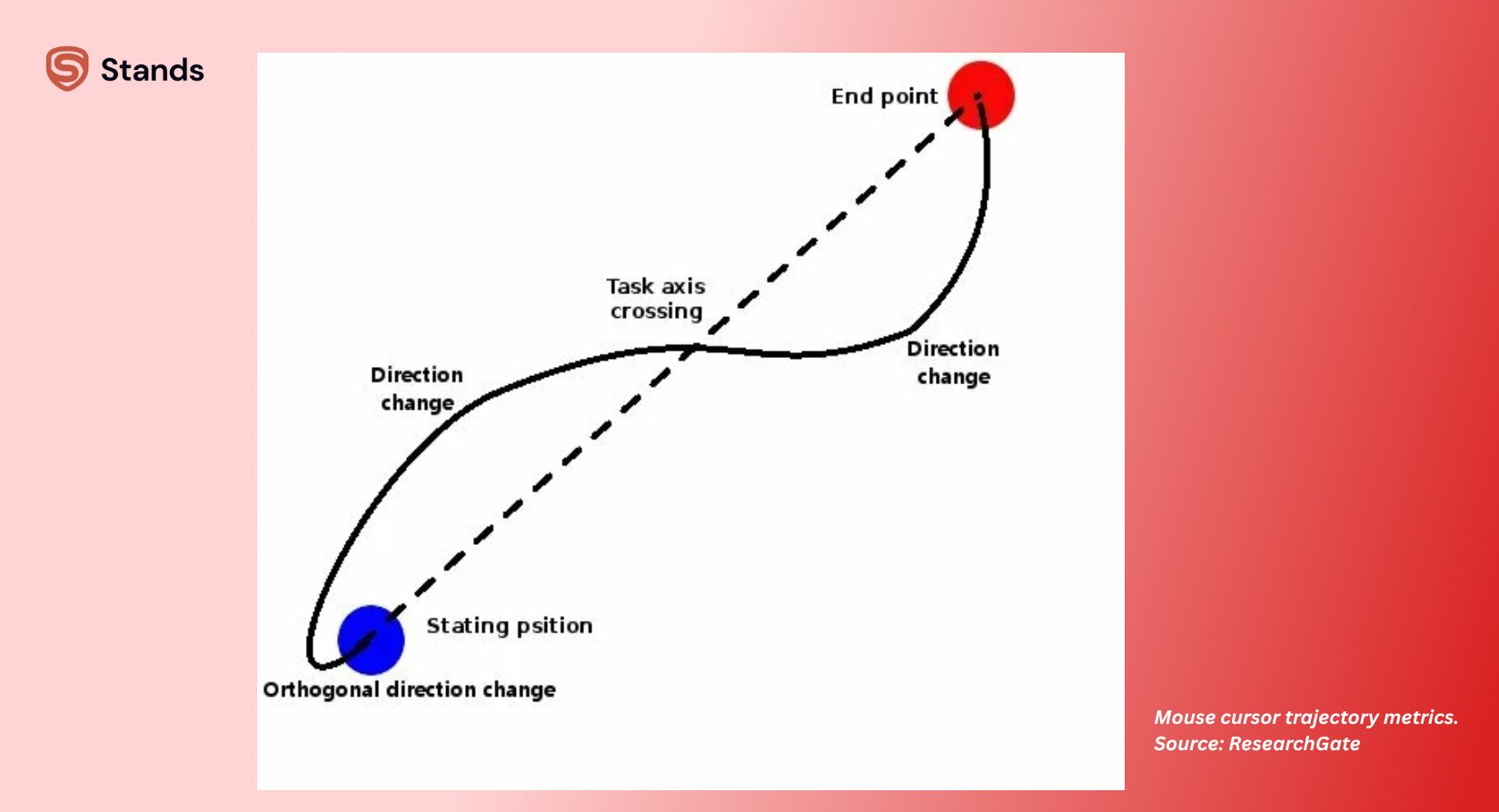
We categorized the raw input streams into three primary interaction variables:
- Path Curvature: We measured the angular deviation of actual cursor trajectories from the geometric straight line connecting movement start and end points, in degrees per pixel of displacement. High curvature indicates arc-shaped movement; low curvature indicates direct, linear targeting [5].
- Scroll Friction: We evaluated scroll friction on touch devices as the deceleration curve of scroll momentum following a swipe gesture, measuring the velocity decay rate in pixels per second squared ($\text{px/s}^2$). Thumb length, grip style, and phone orientation influence this metric.
For pattern recognition, we implemented a Long Short-Term Memory (LSTM) Recurrent Neural Network architecture. Standard classification models evaluate data points independently; an LSTM network retains context across a time-series sequence, making it the optimal architecture for mouse dynamics classification. Prior research confirms LSTM outperforms traditional classifiers for behavioral data [2].
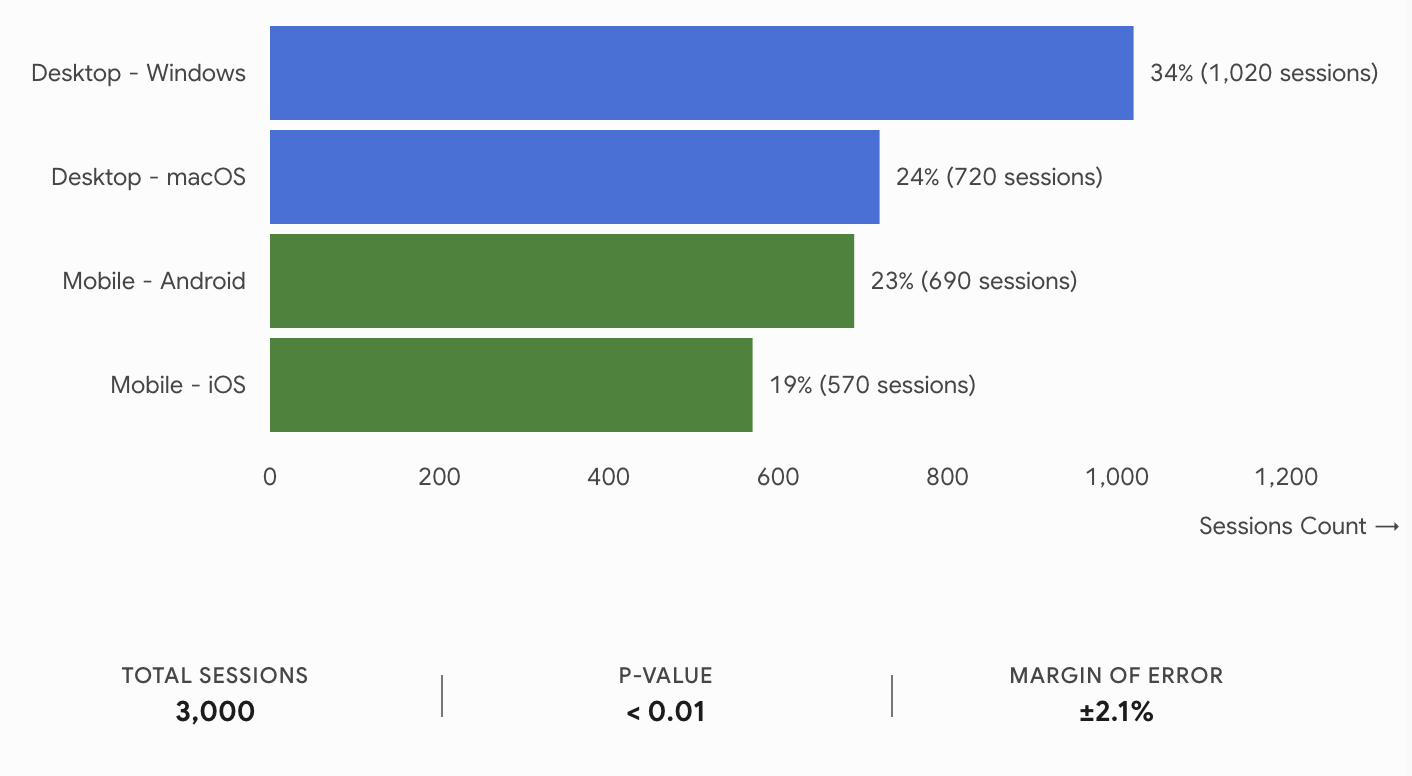
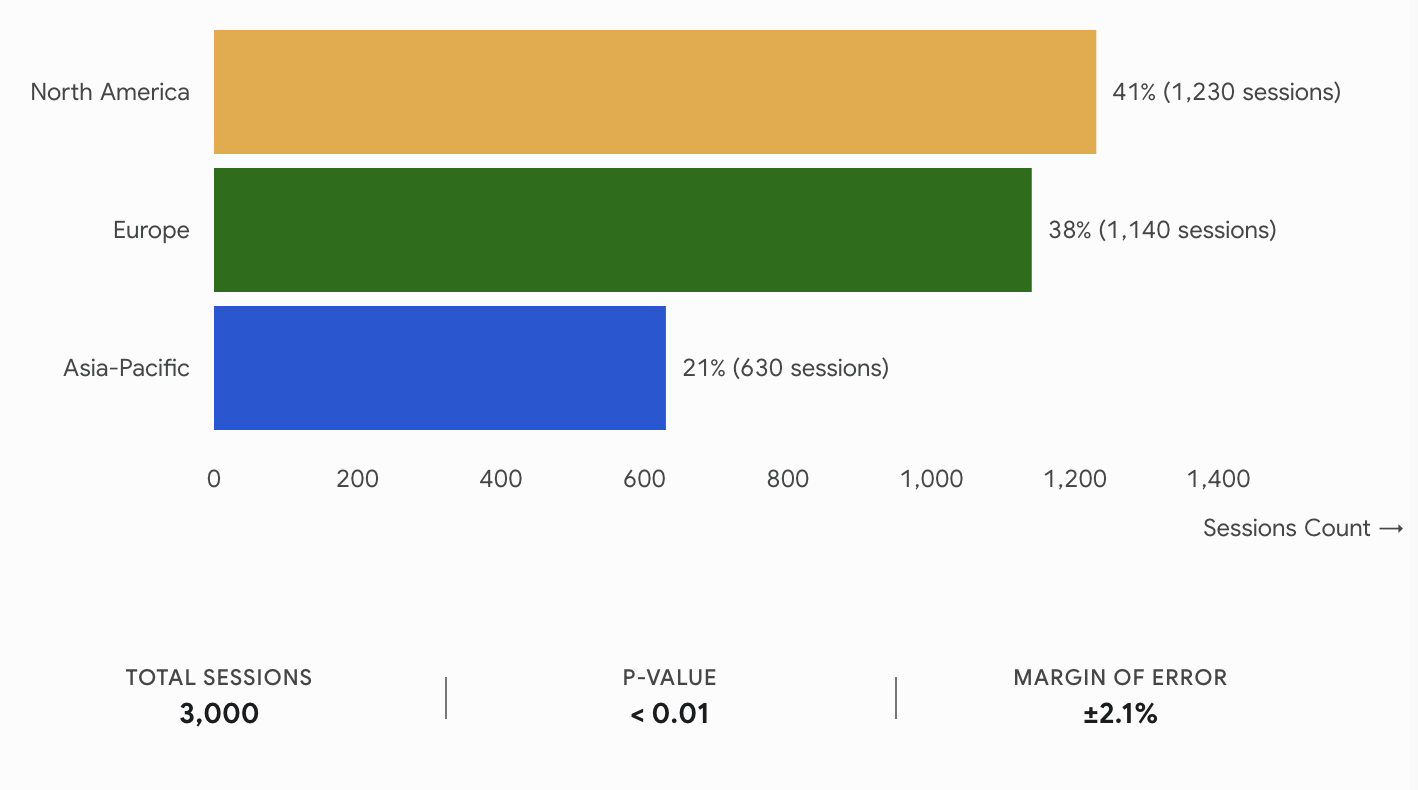
Desktop devices accounted for 58% of the dataset (Windows: 34%, macOS: 24%) and mobile devices comprised 42% (Android: 23%, iOS: 19%). We drew geographic distribution across North America (41%), Europe (38%), and Asia-Pacific (21%). Every session met a minimum duration of 12 seconds of active interaction. We report our results at $p < 0.01$ with a margin of error of $\pm 2.1\%$ across primary metrics.
Biometric Study Composition
Section 3: Findings
Finding 1: 88.2% – Muscle Memory as an Identifier
Stands Research Lab observed that after analyzing the cursor trajectories produced by just three mouse movement events (start point $\rightarrow$ inflection point $\rightarrow$ end point), our LSTM model identified the returning user with 88.2% accuracy. The model required a median time of 12 seconds of active browsing to reach this confidence threshold [1, 5].
The motor cortex and cerebellum govern motor movements below conscious decision-making. The precise arc a user traces when moving a cursor toward a button reflects physical habits rather than conscious intent. These patterns remain consistent across sessions, devices, and websites. Because they exist below conscious awareness, users cannot alter them voluntarily.
For context, facial recognition systems achieve 97% to 99% accuracy in controlled conditions, and fingerprint scanners reach 99.9%. Behavioral mouse biometrics, at 88.2% in real-world browsing conditions, crosses the operational threshold required for commercial tracking and cross-site identification.
Finding 2: 74% – Mobile Scroll as a Fingerprint
On smartphones, the way a user initiates and decelerates a scroll gesture encodes enough information to identify them in 74.0% of cases, independent of device settings, browser choice, or app wrapper.
Touch event APIs expose scroll velocity, deceleration curves, and touch area parameters. These metrics correlate directly with physical factors: thumb length, grip angle, and habitual scrolling speed. The combination produces a signature that operates as a mobile fingerprint.
A platform distinction exists: WebKit-based engines (Safari on iOS) expose touch pressure data natively, whereas Chromium on Android relies on velocity-only scroll modeling. Safari-based sessions produced higher accuracy (78.2%) than Android Chromium sessions (70.1%). The 74.0% figure reflects the average across the full mobile sample.
| Platform / Environment | Metric / Signal Evaluated | Identification Accuracy |
| Desktop (Windows/macOS) | Path Curvature & Click Latency | 88.2% |
| Mobile (iOS Safari) | Velocity Decay & Touch Pressure | 78.2% |
| Mobile (Android Chrome) | Velocity Decay Modeling | 70.1% |
| Combined Mobile Sample | Scroll Friction & Momentum | 74.0% |
| Incognito / Private Mode | Cross-Session Behavioral Matching | 94.0% |
Finding 3: 94% – Incognito Mode Is Not Private
In 94.0% of sessions where users browsed in Incognito or Private mode, our model linked the session to a previously established behavioral profile within the same test environment.

Incognito mode prevents the browser from saving history, cookies, and form data to the local device after the session ends. It does not anonymize device characteristics, browser fingerprints, or behavioral patterns from web servers. The server never writes cookies to the device, but it still analyzes every movement the user makes.
As recent academic findings presented at the ACM Web Conference 2025 confirmed, trackers can still employ fingerprinting techniques to monitor user activity, making Incognito mode an incomplete privacy solution for users concerned about online tracking and data collection [4].
Section 4: The Solution – Signal Jitter
Because behavioral patterns stem from involuntary physical habits, users cannot manually alter cursor movements. Defending against behavioral profiling requires introducing controlled inconsistency into the data layer—a technique known as Signal Jitter.
Signal Jitter injects sub-pixel noise and micro-temporal variance into cursor coordinates and touch event timestamps before transmitting them to page scripts. A displacement of less than one pixel remains imperceptible to the user and does not affect page interactions, but it prevents the AI model from matching trajectory curves to stored profiles [3].
This defense builds on principles that the Brave browser uses in its "farbling" feature, which adds per-session randomization to canvas fingerprinting APIs. Applying noise injection to interaction APIs extends protection to dynamic behavioral metrics.
We re-ran our LSTM model against the same dataset with Signal Jitter active at the data-collection layer in the Stands privacy engine:
| Metric | Without Signal Jitter | With Signal Jitter |
| Desktop Identification Accuracy | 88.2% | 11.4% |
| Mobile Identification Accuracy | 74.0% | 9.8% (estimated) |
| Incognito Session Linking Rate | 94.0% | 8.3% (estimated) |
Signal Jitter reduced desktop identification performance from 88.2% to 11.4% resetting model accuracy to baseline guessing.
Importantly, randomization defenses face limits if trackers observe enough sessions and average across them statistically over time [3]. Signal Jitter requires re-randomization and non-linear displacement curves on every session, which is how Stands implements it, to prevent long-term pattern reconstruction.
Section 5: Legal Context – Where the Law Falls Short
The commercial adoption of behavioral biometrics exposes a gap in privacy law, which regulates static personal data but leaves real-time motor analysis unchecked.
Under GDPR Article 4(14), biometric data includes technical processing of physical, physiological, or behavioral characteristics. However, Article 9 special-category protection applies only when a party processes data "for the purpose of uniquely identifying a natural person" [6, 7]. The EU AI Act similarly focuses on targeted biometric systems without addressing passive web analytics.
This creates a loophole: a tracker collecting mouse movement data for "user experience optimization" or "fraud detection" claims it is not processing biometric data under Article 9, even though the same telemetry enables unique user identification with 88.2% accuracy. Research presented at ACM WWW 2025 confirmed that trackers silently follow users across websites via browser fingerprinting even after users opt out of tracking under GDPR or CCPA [4].
Three policy changes would close this gap:
- Regulatory Classification: The European Data Protection Board (EDPB) must clarify that high-frequency behavioral interaction data capable of identification constitutes biometric data under GDPR Article 9, regardless of stated processing intent [7].
- Browser-Level API Restrictions: The W3C Pointer Events API currently transmits cursor position at full precision without prompt. A standardized opt-in permission model would allow users to limit the telemetry precision available to third-party scripts.
- CCPA Alignment: California lawmakers should update statutory definitions in the CCPA to align with GDPR's broader inclusion of behavioral interaction metrics as protected biometric information [6].

Section 6: Conclusion
This study proves that modern machine learning models can identify web users with 88.2% accuracy in 12 seconds based entirely on mouse and scroll mechanics, rendering traditional cookie controls and private browsing modes obsolete. For millions of users who rely on Incognito modes and VPNs, online anonymity remains an illusion sustained by outdated assumptions about web tracking. Resolving this security risk requires a dual response: active technical defense via Signal Jitter telemetry randomization, combined with regulatory reclassification of behavioral data as protected biometric information. Stands remains committed to researching stateless tracking vectors and building client-side tools that measurably protect web users across major browser platforms.
Author
Roy Rosenfeld is the founder and CEO of Stands (standsapp.org), a cybersecurity and digital privacy company protecting over 3 million active users across Chrome, Edge, Brave, Opera, and Android. Previously a co-founder of Inneractive (acquired by Fyber), Roy brings deep expertise in the economics of digital advertising and browser-level security architecture.
References
- Ahmed, A. et al. (2020). Continuous Authentication Using Mouse Clickstream Data Analysis. arXiv:2312.00802.
- Chen, J. et al. (2024). Performance Evaluation of Lightweight Network-Based Bot Detection Using Mouse Movements. Computers & Security, ScienceDirect. doi:10.1016/j.cose.2024.103850.
- Proceedings of ACM ICSCA. (2025). Breaking the Trackers: A Multi-Module Privacy Framework through Fingerprint Injection and Data Isolation. dl.acm.org/doi/10.1145/3731806.3731843.
- Texas A&M University / Johns Hopkins University. (2025). Websites Are Tracking You Via Browser Fingerprinting. Presented at ACM Web Conference (WWW) 2025. engineering.tamu.edu/news/2025/06/websites-are-tracking-you-via-browser-fingerprinting.
- Gupta, R. (2024). ML-Based User Identification Through Mouse Dynamics. Master's Projects, San Jose State University. scholarworks.sjsu.edu.
- Rakhmetov, B. (2025). Behavioral Biometrics in the European Union: Legal Challenges and Technological Prospects. Journal of Digital Technologies and Law. lawjournal.digital/jour/article/view/511.
- European Data Protection Board. (2025). Guidance on Biometric Data Processing (Article 9, GDPR). edpb.europa.eu.
- Electronic Frontier Foundation. Cover Your Tracks [Browser Fingerprint Testing Engine]. coveryourtracks.eff.org.

