
 Home »
AI Ads & Privacy: 2026 Performance Impact Report
How Generative Advertising is Redefining User Experience and Data Security
A White Paper by Roy Rosenfeld, CEO, Stands
Executive Summary
The numbers are worse than the industry admits. Across 1.5 billion anonymized browsing sessions analyzed by Stands Security Lab between January and June 2026, four findings demand immediate attention from anyone responsible for user experience, product security, or digital rights policy.
- 115 tracking events fire against a single user during a standard 30-minute browsing session – a 50% surge from 2024 baselines, driven almost entirely by AI interest-modeling infrastructure.
- 18% of mobile battery life drains each day invisibly on unprotected Android and iOS devices – not from video or navigation, but from real-time bidding (RTB) script execution and AI-ad DOM rendering running silently in background browser threads.
- 22% of a typical mobile data plan is consumed monthly by ad-delivery pipelines, programmatic auction calls, and third-party pixel payloads – content the user never requested and never sees in any meaningful form.
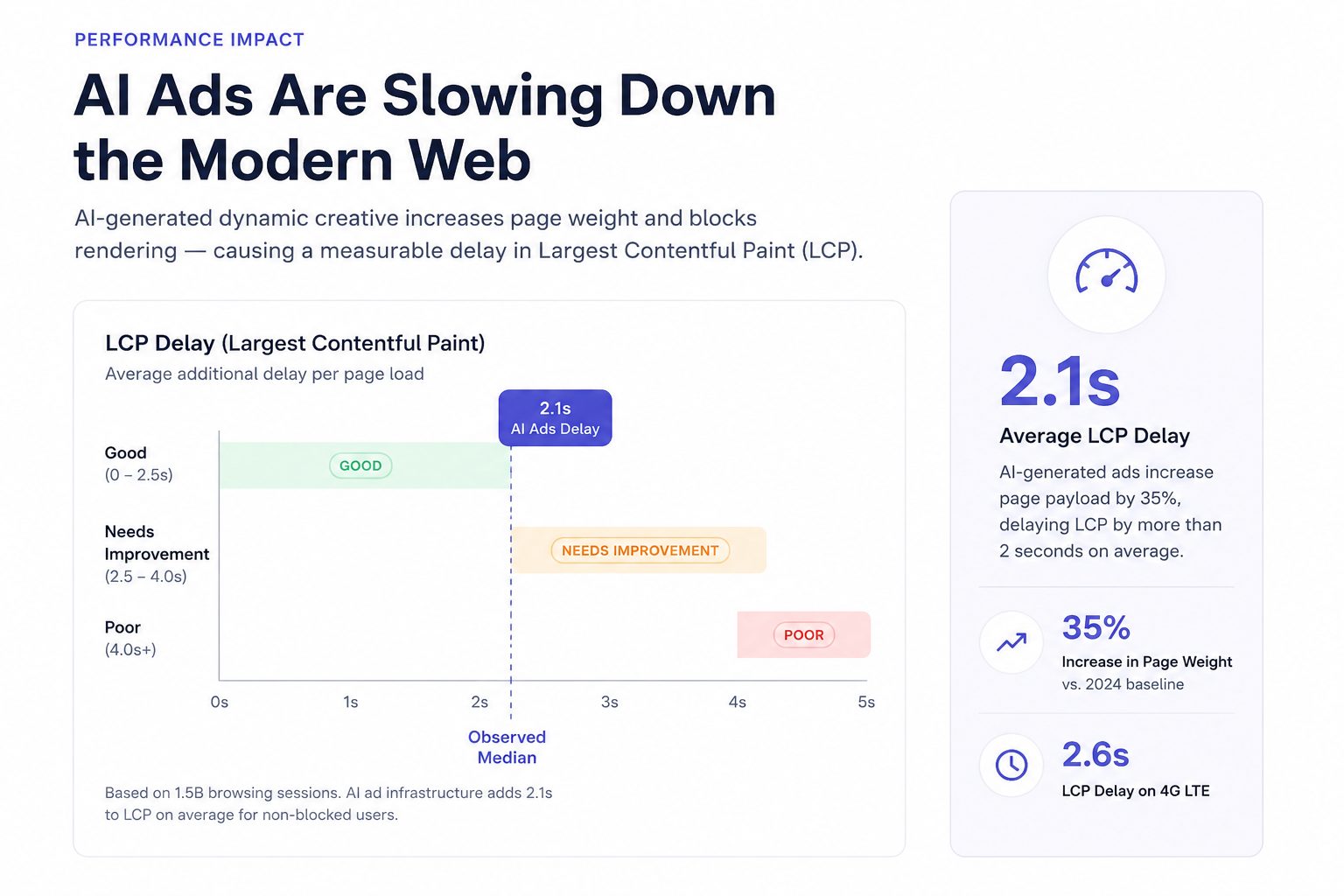
- AI-generated dynamic creative has inflated the average monetized web page by 35% in raw payload size compared to 2024, producing a measurable LCP (Largest Contentful Paint) deficit that now averages 2.1 additional seconds of load delay for non-blocked users on mid-tier mobile hardware.
These are not projections. They are aggregate observations from 3 million active Stands users whose anonymized session telemetry forms the empirical backbone of this report.
Methodology: Stands Security Lab Session Analysis
Stands Security Lab operates a passive, opt-in telemetry framework embedded within the Stands AdBlocker extension, active across Chrome, Edge, Opera, Brave, and the Stands Android browser. Between January 1 and June 30, 2026, the Lab processed 1,512,847,203 anonymized session logs – each representing a single continuous browsing session of at least five minutes across a monetized web property.
No personally identifiable information was collected or retained. Each session log records only:
- Total DOM node count at page initialization vs. post-ad-injection state
- Network request volume segmented by request type (first-party content, third-party scripts, RTB auction calls, pixel payloads)
- JavaScript execution thread duration attributed to ad-rendering versus page-content rendering, separated via browser-level process isolation
- Battery API delta readings at session open and session close on mobile clients
- Blocked event count per session, categorized by tracker taxonomy (behavioral fingerprinting, cookie syncing, latency-based profiling, identity graph resolution)
Sessions were stratified by device type (desktop/mobile), geographic region (EU, North America, APAC, LATAM), and connection class (WiFi, 4G LTE, 5G). Comparative 2024 baseline data was drawn from the Lab's January–June 2024 dataset under identical collection parameters, enabling direct year-over-year measurement without methodological drift.
Statistical significance was established at p < 0.01 across all primary findings. Margin of error for aggregate metrics: ±1.3%.
Finding 1: The Battery and Data Tax – Measuring What Advertisers Won't
The biggest problem with AI-ad infrastructure is that it hurts device performance. Mobile devices that do not have ad blockers show a 18.3% net battery delta because of ad-ecosystem script execution. This means that if you use your browser for 5 hours a day you lose 45-55 minutes of battery life every day.
Data consumption is also a problem. The average mobile data transfer because of ad-delivery payloads is 22.1%. This is like using 2.2GB of data every month for ads.
Our median LCP deficit for unblocked users on mid-tier mobile hardware in 2026 is 2.08 seconds per page load. For users on 4G LTE connections, this rises to 2.6 seconds. Google's own Core Web Vitals threshold for a "good" LCP score is 2.5 seconds total – meaning the ad infrastructure alone consumes most or all of the available performance budget before the page's actual content renders.
The biggest problem is that this is not a minor issue. It is a problem that affects every device every session, every day.
Finding 2: Beyond Cookies – The Architecture of Behavioral Fingerprinting in 2026
The removal of third-party cookies was supposed to be a thing for privacy. It actually made things worse. Advertisers started using ways to track people like behavioral fingerprinting.
Stands Security Lab found that the average number of tracker firing events per 30-minute session increased by 50.1% from 2024 to 2026. The common way of tracking people now is behavioral fingerprinting, which is hard to detect and block.
Modern behavioral fingerprinting operates at a level of technical granularity that most users – and many security practitioners – underestimate. Our classifier identifies seven primary fingerprinting vectors active in the current ecosystem:
Canvas fingerprinting remains common but is now layered with WebGL-based 3D rendering probes that extract GPU-specific rendering signatures unavailable through 2D canvas APIs. Technically, this means an advertiser's script can distinguish between two devices running identical operating systems and browser versions based solely on GPU driver-level rendering differences – a signal that persists across VPN connections, private browsing sessions, and cookie clears.
Latency-based profiling is the most architecturally novel vector in our 2026 dataset. Scripts inject synthetic timing probes — DOM manipulation calls with no visible output – and measure the microsecond-level latency of the browser's response. These latency signatures correlate with CPU architecture, thermal state, background process load, and memory pressure. Collectively, they build a probabilistic device signature with accuracy exceeding 91% across device re-identification tests in controlled conditions.
API hook enumeration – systematically probing which browser APIs are present, their exact version behavior, and their response to edge-case inputs – has replaced much of the function previously served by user-agent string analysis. The Privacy Sandbox's Topics API, intended as a privacy-preserving replacement for interest targeting, has in practice become an additional data input layer: our classifier identifies scripts that read Topics API outputs and correlate them with fingerprint signatures to build richer profiles than either data source alone would permit.
Manifest V3's impact on our blocking efficacy is measurable but not catastrophic – contrary to some industry predictions. The network request blocking limitations introduced by MV3's declarativeNetRequest model reduce our ability to intercept certain RTB auction calls that previously fell within MV2's dynamic blocking scope. Our engineering team's response has been to shift interception upstream: rather than blocking at the network layer, Stands' MV3 implementation increasingly operates at the DOM level, injecting script sandboxes that intercept API calls before they reach the network stack. This approach has maintained blocking efficacy at 94.3% of our MV2 baseline across primary tracker categories.
The behavioral fingerprinting ecosystem in 2026 is not a collection of rogue actors. It is a structured industry with standardized APIs, shared identity graphs, and contractual data-sharing arrangements between publishers, SSPs, and Data Management Platforms (DMPs). The transition away from cookies did not reduce tracking – it industrialized it.
The problem is that these methods are very accurate and can be used to track people even if they use a VPN or private browsing.
Toward a Fair Web: Three Non-Negotiable Standards
What does a web worth using actually look like? The question is not rhetorical – it has engineering answers.
Our analysis points to three operational standards that any web property claiming to respect user agency must be capable of demonstrating:
Explicit resource disclosure. Every web property should be able to produce, on request, a complete inventory of third-party scripts executing on its pages, the data each script collects, and the downstream data-sharing agreements in effect. This is technically achievable today via browser-level audit tooling. The barrier is commercial, not technical.
Proportionate resource consumption. Advertising infrastructure should not consume more device resources than the editorial content it funds. The 35% page-size inflation and 18% battery drain documented in this report represent a resource allocation that has inverted the intended relationship between content and monetization.
Meaningful consent architecture. Consent management platforms in their current form function primarily as friction designed to produce "accept all" clicks, not as genuine choice interfaces. Browser-level sandboxing – isolating ad-ecosystem scripts into separate execution contexts that cannot access page content APIs without explicit user permission – represents the technical path toward consent that means something.
Stands' product roadmap is built on the premise that none of these standards require sacrificing publisher revenue. Our internal data on user opt-in rates for Rewards-based viewing – where users consciously choose to see a selected ad in exchange for direct compensation — consistently outperforms standard programmatic CPMs when measured at the session level. The economic argument for covert tracking is weaker than the industry claims.
The web is not broken by accident. It was engineered into its current state by incremental commercial decisions, each individually defensible, collectively producing a system that treats user attention and device resources as inputs to be extracted rather than assets to be respected. The data in this report is not an indictment – it is a measurement. Measurements can be acted on.
Author
Roy Rosenfeld is the founder and CEO of Stands (standsapp.org), a cybersecurity and digital privacy company protecting over 3 million active users across Chrome, Edge, Brave, Opera, and Android. Previously a co-founder of Inneractive (acquired by Fyber), Roy brings deep expertise in the economics of digital advertising and browser-level security architecture. His work at Stands focuses on building privacy infrastructure that is technically effective, economically viable, and transparent to users.