
 Home »
GDPR vs CCPA: Understanding the Key Differences
If your business collects data online — and honestly, who doesn’t these days? — you’ve probably bumped into the GDPR vs CCPA debate.
Are they basically the same thing? Is CCPA just a California version of GDPR? Do you have to follow both? Well, actually no - they overlap in some areas, but they’re not identical.
In this article, we’re going to check what GDPR and CCPA are, how they differ, and what your business needs to know about GDPR and CCPA compliance.
- What Are GDPR and CCPA?
- Comparison Criteria: GDPR vs CCPA
- Key Differences Between GDPR and CCPA
- Overlapping Requirements and Key Similarities
- What Rights Do Consumers Actually Have?
- Consent and Data Collection: Where It Gets Messy
- Where GDPR and CCPA Overlap
- Penalties: Why You Should Care
- Impact on Businesses: Compliance Challenges
- California GDPR: Is CCPA the Equivalent?
- Looking Ahead: Privacy Isn’t Slowing Down
- FAQ
What Are GDPR and CCPA?
Let us start with the basics.
The General Data Protection Regulation or GDPR is a law from the European Union that keeps the data of people who live in the EU safe. Most likely, you faced this abbreviation if your business collects or uses data from people in the EU. Even if your business is based in the United States, you still have to follow the GDPR rules. It is not really optional.
The California Consumer Privacy Act, or CCPA, is the law in California that deals with privacy. It gives people who live in California control over their personal information. CCPA applies to businesses that meet certain revenue or collect data.
So when someone asks “what is GDPR and CCPA?”, here’s the simple version:
- GDPR protects people in the EU.
- CCPA protects people in California.
- Both set rules for how businesses process the personal data.
Sounds similar, right? Not really. The way they work is where things get interesting.
Comparison Criteria: GDPR vs CCPA
A lot of businesses search for “CCPA vs GDPR”, “difference between GDPR and CCPA”, or “CCPA GDPR compliance” because it actually affects day-to-day operations.
Understanding the difference helps you decide how to handle marketing, cookies, data sharing, and privacy notices. Without this, you could be leaving money — and trust — on the table.
Key Differences Between GDPR and CCPA
Here’s where the difference between GDPR and CCPA really hits home. So let’s check it together.
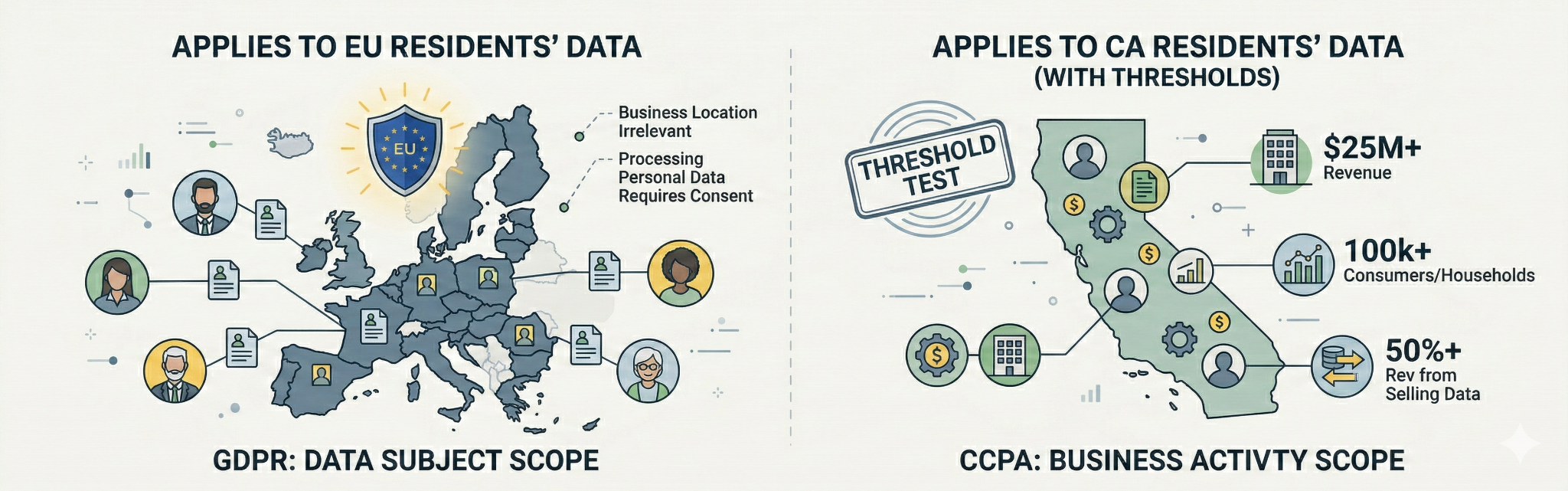
GDPR: Applies based on who the data belongs to
GDPR doesn’t care where your business is. If you’re processing personal data of EU residents, you’re in. Simple as that.
This is why even U.S. companies have GDPR compliance programs. You can’t just say, “I have a business in California, EU rules don’t apply.” Actually, no, GDPR will still apply if you collect EU data.
CCPA: Applies based on business activity
CCPA is a bit pickier. It only applies if your business:
- Collects personal information of California residents
- Is for-profit
- Meets at least one of these:
- $25 million+ annual revenue
- Handles personal information of 100,000+ consumers or households
- Makes 50%+ of revenue from selling personal information
GDPR vs CCPA
Overlapping Requirements and Key Similarities
GDPR and CCPA even use different terms for the things they protect.
- GDPR: “Personal data” — names, emails, IP addresses, device IDs, location data… basically anything that points back to a person.
- CCPA: “Personal information” — similar to GDPR but also includes households and some aggregated data.
The overlap is huge, so building systems that meet GDPR standards usually helps with CCPA compliance too. Now, let’s move to consumers’ rights.
What Rights Do Consumers Actually Have?
This is where GDPR and CCPA compliance get tricky.
GDPR Rights
GDPR focuses on people and gives them a lot of control:
- Right to access their data
- Right to correct wrong info
- Right to delete data
- Right to move data to another service
- Right to object to how data is used
- Right to withdraw consent at any time
Basically, if you collect EU personal data, you need a good process for all this. And of course it is not optional. But what about CCPA rights? How are they different?
CCPA Rights
CCPA focuses more on transparency:
- Right to know what personal information is collected
- Right to delete personal information
- Right to opt out of selling or sharing personal information
- Right to be treated fairly if they exercise their rights
Do you notice the difference? GDPR is mainly about lawful processing and consent. Meanwhile, CCPA is more about transparency and opt-out options. So, actually, no, they’re not interchangeable.

Consent and Data Collection: Where It Gets Messy
Here’s a big one. Consent rules under GDPR and CCPA are not the same.
- CCPA: Consent is not generally required upfront. You just need to provide notice and let people opt out of selling/sharing data.
So if you’re running a Chrome AdBlocker, an Opera AdBlocker, or any browser tool, you actually need to make sure your tracking disclosures are clear. Otherwise, you’re in hot water.
At Stands, privacy isn’t an afterthought — check Stands’ Stand on Privacy to see how transparency works in practice.
Where GDPR and CCPA Overlap
Even though they’re different, GDPR and CCPA do share some core principles:
- Transparency about what data is collected
- Clear privacy notices
- Mechanisms for responding to access and deletion requests
- Accountability when sharing data with third parties
Basically, if you get GDPR compliance right, you’re already halfway toward CCPA compliance.
Penalties: Why You Should Care
GDPR fines can be huge — up to 4% of global revenue or €20 million. Ouch.
CCPA fines are generally smaller, but CPRA added enforcement teeth with the California Privacy Protection Agency. Plus, consumers can sue in certain breach scenarios.
So yes, the financial risk is real — but the reputational hit is often worse. Actually, no one wants a public privacy scandal. Even a single data breach headline can tank customer trust overnight. And rebuilding that trust? It takes years, not weeks.
Impact on Businesses: Compliance Challenges
If you’re wondering how GDPR and CCPA compliance impact operations, here’s the short list:
- Where do you collect personal data of EU or California residents?
- Do your privacy notices clearly explain what you collect?
- Do you have a system to respond to access, deletion, and opt-out requests?
If your tools include third-party data or ad tech, it’s even more important. A misstep here can have serious consequences.
Stands integrates privacy into product design through Stands AdBlocker — making it easier to meet both GDPR and CCPA standards. Simple as that.

California GDPR: Is CCPA the Equivalent?
People often search for terms like “California GDPR” or “California version of GDPR.”
Here’s the truth:
- GDPR is comprehensive and consent-focused, applying globally to EU residents.
- CCPA (and CPRA) is transparency and opt-out-focused for California residents.
So calling CCPA “California GDPR” is misleading. Not really the same thing, though CPRA does bring California closer to EU-style protections.
Looking Ahead: Privacy Isn’t Slowing Down
Privacy regulations are expanding. Other U.S. states are introducing laws. Federal proposals are in the works. Users are more aware than ever about tracking, cookies, and personal information.
If you treat privacy as a one-time project, you’ll be scrambling later. If you bake it into your systems, products, and culture, you’ll stay ahead. Actually, no one wants to get caught off guard by a new law. Staying on top now makes life easier later and keeps customers happy.

FAQ
Does CCPA apply to companies outside California?
Yes. If your business meets the thresholds and handles personal information of California residents, CCPA applies even if you’re based elsewhere. Actually, no exceptions here.
What are the main consumer rights under GDPR?
GDPR gives people access, correction, deletion, portability, and the ability to object to processing. Consent can also be withdrawn at any time.
How do GDPR and CCPA handle data breaches?
GDPR requires notifications to regulators within 72 hours for certain breaches. CCPA allows consumers to pursue statutory damages for breaches in some cases.
Is consent required for all data collection under CCPA?
No. CCPA mainly focuses on notice and opt-out. Consent is generally not required.
What is the California Privacy Rights Act (CPRA)?
CPRA expands CCPA, adding protections for sensitive personal information and creating the California Privacy Protection Agency for enforcement.

